


April 22, 2024

In Canada’s competitive used car market, mileage myths are quietly costing sellers tens of thousands of dollars every year. Understanding the real cost behind odometer readings and vehicle history can help Canadian sellers save money and avoid common pitfalls.
Canadian private sellers and small dealers are leaving thousands of dollars on the table by believing outdated mileage myths. In the tight 2024-2026 used car market, these misconceptions quietly drain wallets across every province.
The Canadian used vehicle market remains extraordinarily tight through 2024-2026. New vehicle prices hover around $48,000-$52,000 CAD, pushing buyers into the used segment where demand outstrips supply by 20-30% in provinces like Ontario and British Columbia.
Canada’s average annual driving distance sits at 15,000-20,000 km per Statistics Canada data. This means a 10-year-old car with 150,000-200,000 km represents typical usage—not abuse. Yet sellers who panic about the odometer routinely discount healthy vehicles by $1,000-$4,000 below comparable condition-based listings.
Consider this real example: A 2016 Honda Civic in Calgary with 210,000 km and full dealer-stamped service history sold for $12,500 CAD. Meanwhile, a similar Civic in southern Ontario with only 120,000 km but spotty maintenance fetched just $11,200 after buyer hesitancy. The truth? Higher mileage with documentation beats suspicious low-km neglect every time.
This is the most common miscalculation in Canadian appraisals: sellers assume anything under 100,000 km is a gold mine regardless of age or maintenance.
Buyers and dealers now scrutinize kilometres per year. A 10-year-old SUV at 80,000 km (8,000 km/year) raises red flags for underuse, while 180,000 km on the same vehicle signals normal, healthy operation.
Long-sitting, rarely-driven vehicles develop hidden issues:
CAA pre-purchase inspection reports show low-km cars averaging 1.5 major defects versus 0.8 for average-use equivalents. Sellers banking their entire asking price on the odometer are often shocked when serious buyers adjust value downward based on overall condition.
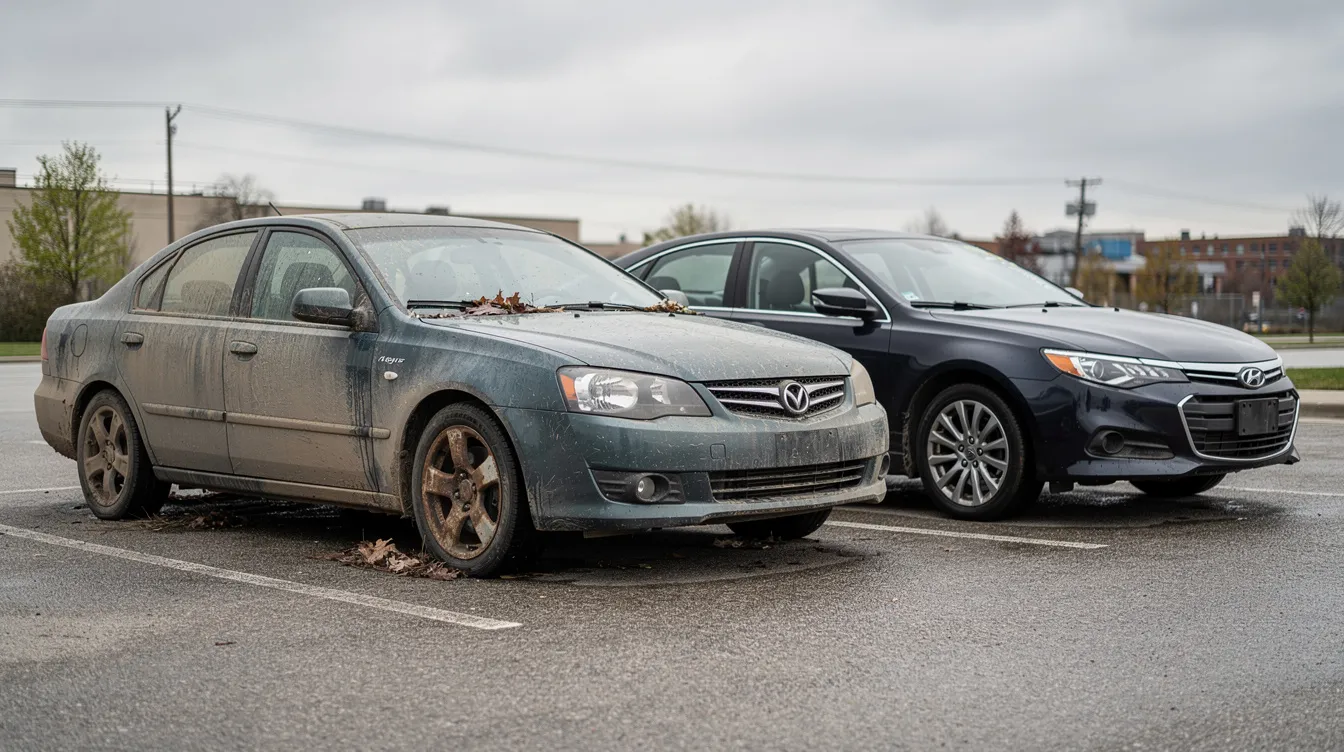
Many Canadians assume once a vehicle passes 150,000-200,000 km, it’s only worth wholesale or parts money—even if it runs perfectly.
Modern vehicles, especially Japanese and Korean nameplates like Toyota, Honda, Hyundai, and Kia, routinely exceed 250,000-300,000 km in Canadian winters with proper maintenance. Consumer Reports longevity data shows 2.5% of Toyotas reaching 400,000 km.
Highway kilometres matter too. Calgary-Edmonton hauls or GTA 401 commutes inflict 30-50% less drivetrain wear than stop-go city driving. Effectively, 220,000 highway km equals roughly 140,000 city km in longevity terms.
Key maintenance milestones Canadian buyers look for around 150,000-220,000 km:
| Service | Typical Cost | Interval |
|---|---|---|
| Timing belt/chain inspection | $800-$1,500 | Every 100,000-160,000 km |
| Transmission fluid flush | $300-$600 | Every 80,000 km |
| Brake rotor replacement | $800-$1,200 per axle | Every 60,000-100,000 km |
| Suspension bushings | $500-$1,000 | As needed |
Sellers presenting invoices for these services justify 10-20% higher prices. Keep organized records and mention recent big-ticket maintenance in your listing.
CBC’s “Go Public” investigations from 2023-2025 exposed over 500 cases of odometer fraud annually in Canada. A 2024 Toronto ring was caught reprogramming digital odometers via OBD-II ports using $200-$500 tools, swapping clusters from wrecked vehicles, or flashing ECMs.
Regulators are responding. OMVIC in Ontario probed 1,200+ complaints in 2024 (up 35% from 2022). AMVIC in Alberta issued 400 fines totaling $2.5 million. BC’s VSA flagged 300 dealer-involved rollbacks.
This odometer tampering epidemic damages honest sellers too. Suspicion around “too low” mileage leads educated buyers to lowball genuine one-owner vehicles by $1,500-$3,000—or walk away entirely.
Protect yourself: pull a recent vehicle history report, verify the odometer reading against past entries, and share this documentation with buyers or services like Purr during appraisal to prove your kilometres are legitimate.
Many sellers assume the odometer is the only thing shoppers glance at on Kijiji or Facebook Marketplace, so they under-invest in everything else.
Serious Canadian buyers and professional appraisers weigh these factors heavily:
In Ontario and Quebec, frame rust from salted roads often matters more than kilometres. CAA reports that 35% of 10+ year vehicles need $2,000+ rust repairs despite low km.
Investments like $200 detailing, $150 safety certificates, and $80 oil changes yield 8-12% price uplift—outpacing any apology for normal kilometres. Data-driven valuations like those from Purr factor in this broader picture.
When Canadian sellers see similar cars online with 40,000-60,000 fewer kilometres, they often slash their price instead of improving their listing.
Higher-mileage vehicles command strong prices when listings clearly communicate:
Practical listing upgrades that cost little but add perceived value:
A 2017 Mazda CX-5 with 195,000 km in Edmonton sold near Black Book top value because the seller showed impeccable maintenance. A lower-km CX-5 with no records sat unsold after repeated cuts.
Use third-party valuations—like an online instant offer from Purr—as negotiation leverage showing buyers a professional platform recognizes fair value even at higher kilometres.
Many owners believe that car dealerships and modern platforms automatically lowball any vehicle over 150,000 km, forcing them into stressful private sales.
Reputable Canadian buyers, including online platforms like Purr, value vehicles using national transaction data, trim-level specifics, provincial market trends, and inspection results—not arbitrary km penalties.
While some registered dealerships shy away from higher-km inventory, digital buyers see opportunity in reliable, well-maintained cars for Canada’s budget-conscious segments.
Consider the hidden costs of private sale:
Compare that to the certainty of a transparent appraisal and quick sale through services like Purr’s sell flow.
Misguided beliefs about good mileage lead Canadians to underprice healthy vehicles, chase unicorn low-km units, and overlook odometer fraud warning signs.
These myths cost money through:
Between underpricing and unnecessary reconditioning, individual sellers forfeit $1,000-$5,000 per transaction in current market conditions. The cure isn’t gaming the odometer—it’s understanding what Canadian buyers actually value: honesty, documentation, and realistic pricing.
Break free from mileage myths with this preparation checklist:
Write listings that balance honesty with strengths: “Highway-driven between Ottawa and Montreal, one owner, full maintenance at Honda Gatineau, new Michelin winter tires in 2025.”
Set asking price using three reference points: provincial guide ranges, local listings, and a professional appraisal from a buyer like Purr. Sellers who prefer skipping DIY can start at purr.ca/free-appraisal and either sell directly or use the information for smarter negotiations.
Purr’s mission in the Canadian market is making buying and selling vehicles calmer and more transparent—more contented purr than stressful haggle over one number.
Purr’s valuations weigh multiple data points: make, model, trim, province, accident records, service history, ownership count, and current demand in specific Canadian cities. When sellers share thorough documentation, Purr often makes more competitive offers on higher-km vehicles than traditional buyers clinging to old mileage rules.
Buyers on purr.ca/buy benefit too, accessing vehicles valued on real-world condition rather than arbitrary kilometre cut-offs. This represents a broader shift in Canada’s automotive industry: away from mileage myths, toward data-driven decisions protecting everyone’s budget.
There’s no universal threshold. Many well-maintained vehicles run 250,000-300,000 km or more, especially highway-driven models from reliable brands. Focus on kilometres per year (12,000-18,000 is normal), documented maintenance, and accident history rather than rejecting anything above 150,000 km. Frame your vehicle’s mileage honestly and back it up with records.
In provinces like Ontario, Quebec, New Brunswick, and Nova Scotia, serious structural rust can be a bigger red flag than high kilometres. It affects safety and repairability. Get underbody photos or a mechanic’s assessment, and mention rustproofing in listings. Platforms discount heavily for advanced rust even when odometers look attractive.
Obtain a current CARFAX Canada report, gather past service records showing km entries, and print manufacturer service histories from car dealerships where possible. Invite serious buyers to speak with your regular mechanic or review inspection reports showing consistent km progression. Sharing documentation upfront builds trust and supports stronger asking prices.
Check your own car’s history via CARFAX before listing. Use licensed dealers or reputable platforms regulated in Canada. Keep copies of all documents showing mileage at time of sale. If discrepancies emerge later, contact the buyer immediately and reach out to provincial regulators like OMVIC, AMVIC, or the VSA.
While some private sales yield higher prices, many sellers underestimate how data-backed appraisals set realistic, defensible asking prices. Tools like Purr’s free online appraisal provide a baseline rooted in current Canadian market data, preventing underpricing or overpricing that leads to long delays. Even sellers choosing private sale benefit from starting with professional valuation.


